
Why Smarter Verification Is Becoming Essential for Philanthropy Platforms
May 18, 2026
first-story


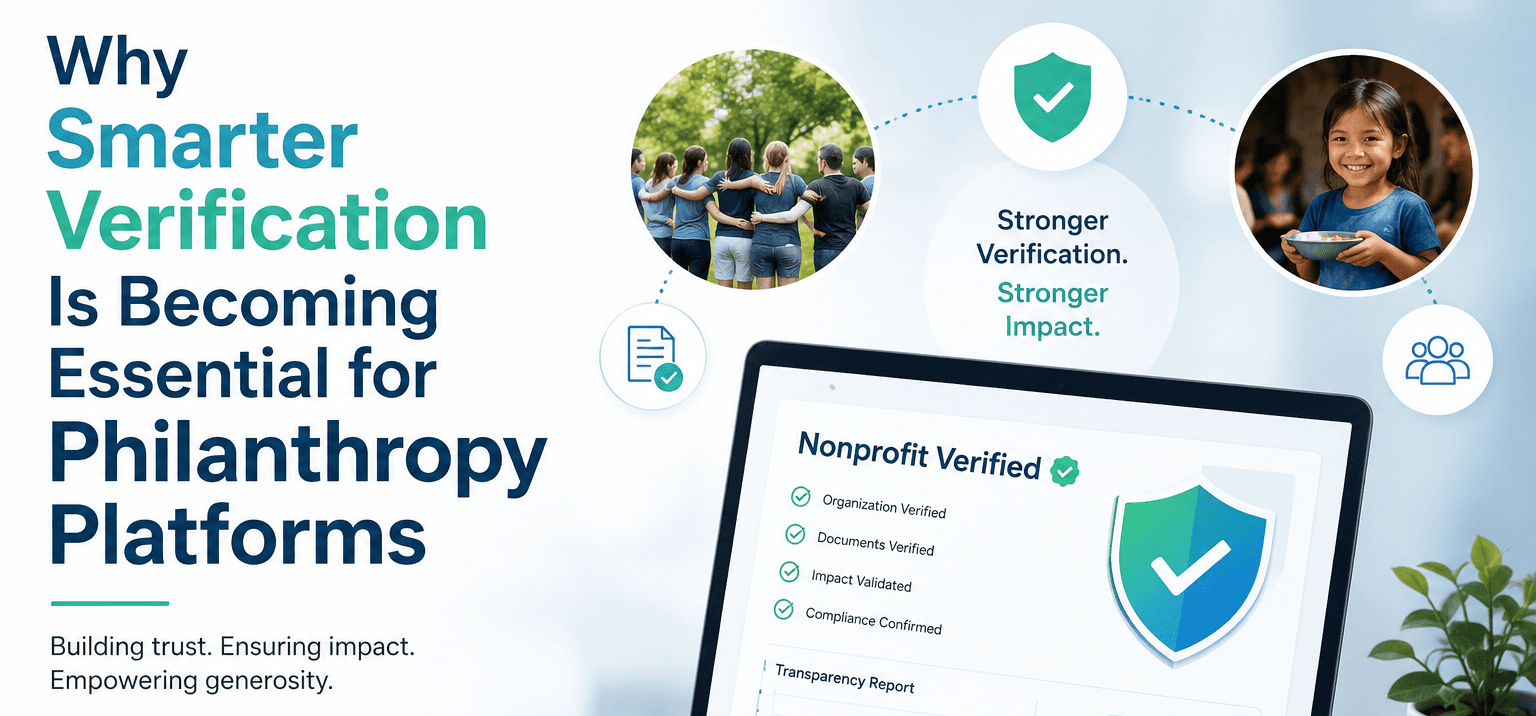
Smarter verification tools are helping philanthropy platforms improve transparency, reduce fraud, and strengthen donor trust.
Something shifted in the way people give money online, and it did not happen overnight. The years between 2020 and 2024 saw an enormous surge in digital charitable giving — driven by pandemic relief campaigns, social justice fundraising, and disaster response efforts that moved almost entirely onto online platforms. Hundreds of millions of dollars moved through crowdfunding pages, donor-advised funds, and giving portals in compressed timeframes, often with minimal friction between a donor's impulse and their payment.
That speed was celebrated at the time. It was also exploited. Fraudulent campaigns mimicking legitimate relief organizations appeared within hours of major news events. Donors who gave generously and quickly discovered later that the organization they supported had lapsed tax-exempt status, or did not exist in any official registry at all. The consequence was not just financial harm to individual donors. It was something harder to rebuild: trust in the infrastructure of online giving itself.
What the Data Tells Us About Shifting Donor Behavior
Donor behavior has changed in measurable ways since 2020. Online giving crossed 12 percent of total U.S. charitable donations by 2023 according to Blackbaud's Charitable Giving Report. At the same time, average online gift sizes declined, reflecting broader participation but more cautious individual decisions.
Donor retention rates on digital platforms have also fallen. First-time online donors are less likely to give again than they were pre-2020 — a pattern researchers attribute to inbox fatigue, data privacy concerns, and uncertainty about whether the organizations they supported were actually legitimate.
"Donors are not becoming less generous. They are becoming more selective. They want evidence before they give, not reassurance after."
That selectivity is showing up in platform behavior. Donors increasingly look for third-party legitimacy signals before completing a transaction — charity ratings, IRS confirmation badges, transparency seals. Platforms that surface these signals convert better. Platforms that do not are losing donors to ones that do.
The Verification Gap That Existed Before 2020
Before digital giving accelerated scrutiny, nonprofit verification on most platforms was a one-time manual process. An organization submitted an IRS determination letter during onboarding, a staff member reviewed it, and that was largely the end of it.
This approach carried two fundamental weaknesses. IRS determination letters do not expire, but the tax-exempt status they confirm very much can. The IRS automatically revokes exemptions when organizations fail to file required annual returns for three consecutive years. A platform relying on a 2015 determination letter had no way of knowing a nonprofit's status had been revoked in 2019.
The second weakness is that onboarding verification does nothing to catch changes occurring while an organization is actively fundraising. A twelve-month campaign could span an exemption revocation with no flag ever raised.
How Platforms Are Responding
The platforms investing most seriously in this problem have moved away from single-source, single-moment verification toward what practitioners call a verification stack — layered data sources queried at different stages of the platform relationship.
The first layer replaces manual document review with live API calls at the point of application. Pactman's Nonprofit Check Plus API handles this with real-time EIN lookups returning current exemption status in structured JSON — built specifically for programmatic integration rather than manual lookups. It offers a permanently free tier, meaningful for smaller platforms building their first automated layer. Candid, formerly GuideStar, serves platforms requiring deeper due diligence, providing 990 financial filings and governance data via API, though without a free access option.
The IRS Business Master File — a monthly bulk extract of all registered tax-exempt organizations — remains the authoritative underlying source for much of this data. It is free but not an API, requiring significant engineering investment to query in real time.
The second layer adds accountability context. Charity Navigator ratings, accessible via API, give platforms financial health and transparency scores to surface to donors. BBB Wise Giving Alliance accreditation adds qualitative governance assessment. Together these signals translate backend verification into visible donor-facing trust indicators.
The third layer — ongoing monitoring — is where most platforms were most deficient before 2020. Scheduled monthly batch re-verification, or event-triggered checks when campaigns cross donation thresholds, catches status changes that occur after onboarding. This is no longer optional for platforms handling significant transaction volume.
What Donors Actually See
Backend infrastructure only matters insofar as it changes the donor experience. The platforms doing this well are translating verification work into visible signals at the point of giving: verified badges that confirm active status checks rather than historical paperwork, transparency ratings from Charity Navigator, and direct links to IRS records for donors who want to verify independently.
"Transparency is not just an ethical obligation for platforms. It is a product feature. Donors who feel informed give more and come back more often."
Research consistently shows trust signals at the point of giving increase both conversion rates and average gift sizes. The investment in verification infrastructure has a measurable return in donor behavior — not just risk reduction.
What Still Needs Solving
Current systems have real limitations worth acknowledging. Database lag is structural — APIs depend on IRS data updated monthly, meaning a recent revocation may not appear anywhere for weeks. Smaller and newer nonprofits remain underrepresented in third-party databases, creating friction that disproportionately affects grassroots organizations. And international giving remains a largely unsolved problem — everything described here applies to U.S. 501(c)(3) organizations, leaving donors giving internationally in a far less developed verification landscape.
The Larger Shift
Verification is moving from a one-time onboarding event to continuous background infrastructure. APIs have made real-time status checks feasible for platforms of any size. Donor expectations — shaped by years of fraud cases and growing financial literacy — are pushing platforms to make that work visible.
The platforms defining the next decade of digital philanthropy are treating trust as foundational infrastructure, not a marketing feature. Donors have changed. The platforms building to meet that change are constructing something more durable than a giving tool — they are building the conditions under which generosity can actually function at scale.
- Peace & Security
- Technology
- Economic Power
- Education
- First Story
- Global