
What Is Email Forensics? Understanding the Role of Email Investigations
May 16, 2026
story


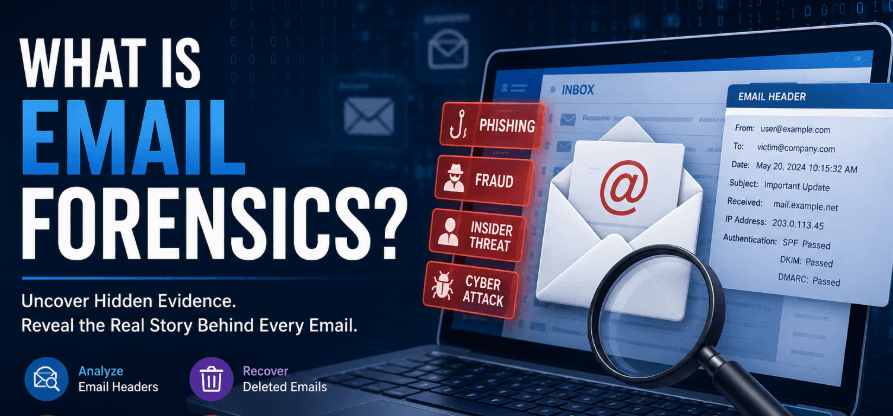
Understanding Email Forensics: Uncovering Hidden Evidence Behind Suspicious Emails
Quick Answer
Email forensics is the process of collecting, preserving, analyzing, and investigating email data to identify digital evidence related to phishing attacks, fraud, insider threats, or cybercrime. Modern investigators often rely on email forensics tools to examine hidden email details, recover deleted communication, and analyze suspicious activities efficiently.
Why Emails Are Important Digital Evidence
Emails are now considered one of the most valuable sources of digital evidence in cyber investigations. Many phishing scams, business email compromise attacks, insider leaks, and financial fraud incidents begin with a suspicious email.
While ordinary users only read the visible message, investigators look deeper into hidden technical information stored behind every email. These details can reveal:
- The sender’s actual origin
- Mail servers involved in delivery
- Timestamp information
- Authentication records
- Suspicious routing behavior
An email can be compared to a shipped package. Someone may write a fake sender name on the label, but investigators can still analyze delivery routes and checkpoints to discover its actual source. This is where email forensic analysis becomes important.
How Email Forensics Works
Professional email investigations follow a structured process to ensure evidence remains accurate and legally valid. Investigators first collect mailbox data carefully to avoid altering important evidence during examination.
After preservation, investigators start analyzing hidden technical information inside the mailbox environment.
Common investigation areas include:
- Email headers
- Metadata
- Attachments
- Sender information
- Login activity
- Deleted messages
- Communication timelines
- Behavioral patterns
In modern cybercrime cases, investigators may need to analyze thousands or even millions of emails spread across PST files, OST files, cloud mailboxes, and archived servers. Due to this, organizations often depend on email forensics tools to simplify large-scale investigations.
Hidden Details Investigators Analyze
One of the most important aspects of email forensics is examining hidden evidence that users normally cannot see.
For example:
- Email metadata can reveal when a message was sent and how it traveled between servers.
- Email headers help investigators identify spoofed sender addresses and suspicious routing activity.
- Attachments are examined for phishing links, malware payloads, or manipulated documents.
- Deleted emails may still leave traces inside mailbox databases and backup storage systems.
Even a small technical detail can help investigators determine whether an email is legitimate or part of a phishing campaign.
Challenges in Large Email Investigations
Investigating a single suspicious email may sound simple, but real investigations usually involve massive amounts of mailbox data collected over several years.
Investigators often face challenges such as:
- Large PST and OST files
- Deleted communication
- Encrypted emails
- Hidden attachments
- Multiple mailbox formats
- Fake sender identities
- Scattered archive data
Finding one important message inside thousands of emails can be extremely difficult without a proper workflow. This is why manual investigation methods are no longer sufficient for modern forensic cases.
Common Mistakes During Email Analysis
Many investigations fail because hidden technical evidence is ignored too early. Attackers often use familiar display names to impersonate trusted companies or executives.
Some common email investigation mistakes include:
- Ignoring email headers
- Trusting visible sender names
- Skipping attachment analysis
- Failing to preserve timestamps
- Forgetting deleted folders
- Deleting suspicious emails too quickly
Preserving original evidence is one of the most important steps before starting any forensic analysis.
How Modern Email Investigations Are Performed
Modern investigations involve collecting mailbox data from multiple environments such as cloud servers, local systems, archived mailboxes, PST files, OST files, and backup storage.
Performing manual analysis on such large datasets can take significant time. Due to this, investigators now prefer organized workflows supported by email forensics tools that help simplify evidence examination.
- Advanced forensic platforms help investigators:
- Organize mailbox data
- Analyze suspicious communication
- Detect phishing attempts
- Recover deleted evidence
- Identify unusual activity patterns
- Review attachments efficiently
Instead of manually searching through emails one by one, investigators can focus more effectively on suspicious behavior and digital evidence.
Wrapping Up
Emails may look simple on the surface, but they contain hidden technical information capable of revealing phishing attacks, insider threats, fraud attempts, and cyber incidents.
Understanding how email investigations work has become increasingly important in modern cybersecurity environments. From analyzing suspicious communication to recovering deleted evidence, forensic investigations help organizations uncover critical details that ordinary users usually never notice.
As cyber investigations continue to grow in size and complexity, the importance of organized workflows and advanced email forensics tools will continue increasing.
- South and Central Asia