
THE SENTINEL’S MATH: WHY WE ARE FAILING TO PROTECT WOMEN IN CONFLICT (AND HOW WE FIX IT)
Mar 20, 2026
story
Seeking
Visibility


THE SENTINEL’S MATH: WHY WE ARE FAILING TO PROTECT WOMEN IN CONFLICT (AND HOW WE FIX IT)
THE SENTINEL’S MATH: WHY WE ARE FAILING TO PROTECT WOMEN IN CONFLICT (AND HOW WE FIX IT)
By Ruth Aigbe, PhD Researcher & Security Architect
For decades, the global community has operated under a comfortable illusion. We have signed treaties, attended high-level summits in Geneva and New York, and drafted ambitious mandates on “Women, Peace, and Security” (WPS). We have told the world that we are including women in peace processes.
But as a researcher standing at the intersection of Security and Strategic Studies in Nigeria, I have to speak a difficult truth: Inclusion is not the same as Protection. And a seat at the table is useless if the floor beneath that table is collapsing.
In the kinetic theaters of the Sahel, the Lake Chad Basin, and beyond, our current stabilization models are suffering from a fatal Implementation Gap. We measure the success of a military mission by territory gained or insurgent leaders neutralized. We measure gender success by a headcount of women in a room.
What we are not measuring and what we are consistently losing is the Civilian Peacebuilding Capital that actually holds a society together.
The Invisible Erasure
When a conflict turns kinetic, the first thing to be securitized or destroyed isn't just military infrastructure; it is the Resource-Nexus.
I have watched as the primary collectors of water and providers of sanitation, predominantly women and girls become the first targets of systemic erasure. When a water point is seized by an armed group or rendered inaccessible due to predatory corridors, the social fabric doesn't just tear; it dissolves. If a mother cannot safely access water for her children without facing the threat of abduction or assault, the state has already lost that territory, regardless of who flies their flag over the local barracks.
We have treated these as soft issues or humanitarian concerns. I am here to argue that they are Hard Security Threats.
Introducing the Gendered Sentinel Framework (GSF)
I realized that if we wanted to change how Mission Commanders and Policy Directors viewed these risks, we had to change the language we used to describe them. We had to move from sociology to Security Architecture. This is why I developed the Gendered Sentinel Framework (GSF).
The GSF is a proprietary technical standard designed to bridge the gap between high-level policy and ground-level Command and Control (C2). It treats the protection of civilian agency not as a kind gesture, but as a high-value strategic asset.
At the heart of this framework is a mathematical formula I developed to quantify the exact point of communal collapse: The Water-Security Distance Ratio (WSDR).
WSDR = D×T
S×A
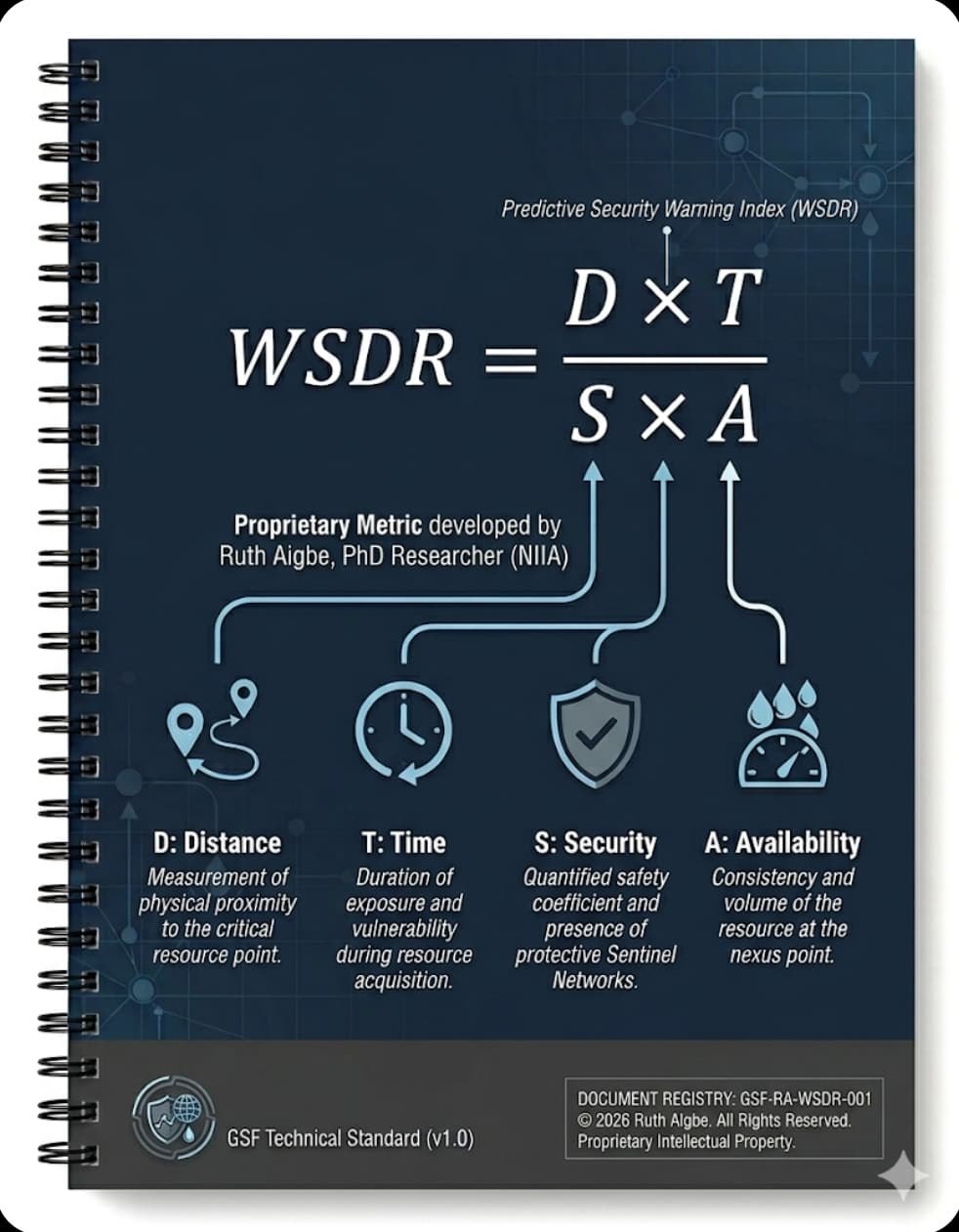
In this formula, we audit the physical Distance (D), the Time (T) spent in exposure, the Security (S) safety coefficient, and the Availability (A) of the resource. By calculating this ratio, we can move from guessing if a community is at risk to Predicting it.
When the WSDR score spikes, it is a Pre-Kinetic Warning. It tells us that the community is reaching a breaking point. It allows for targeted intervention before the spike in Gender-Based Violence (GBV) or the total displacement of the civilian population.
The Three Pillars of the Sentinel
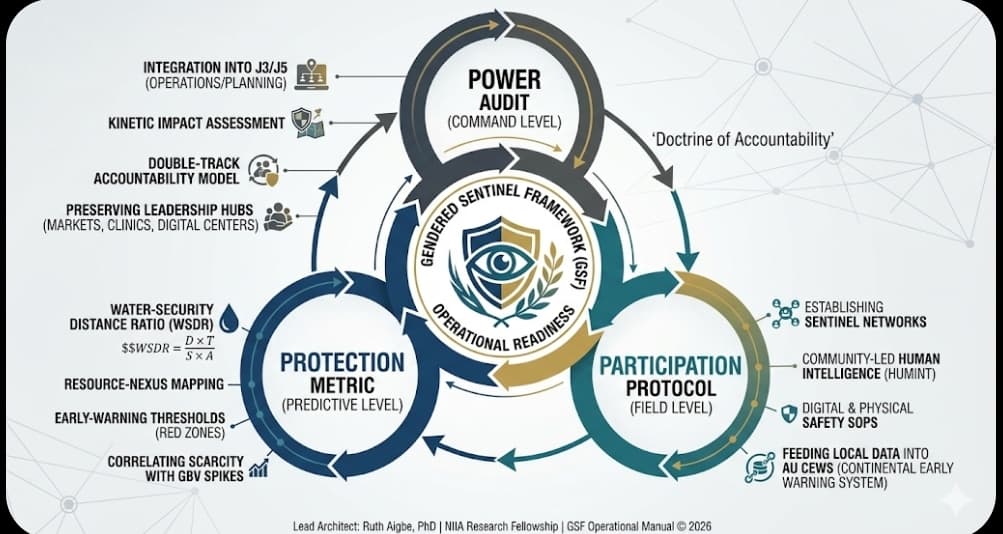
The GSF does not just observe; it operationalizes. It is built on three proprietary modules:
* Module A: The Power Audit. We integrate gendered intelligence directly into mission planning (J3/J5). We ask: Will this military objective inadvertently destroy the leadership hubs that will be needed to govern this town once the fighting stops?
* Module B: The Protection Metric. This is where the WSDR lives. We use geospatial data and ground-truth reporting to map Predatory Corridors and secure them.
* Module C: The Participation Protocol. We establish Sentinel Networks circles of local women leaders who act as an early-warning system.
Using encrypted mobile interfaces and Circular Observational Inquiry (COI), these women provide real-time Human Intelligence (HUMINT) that a satellite could never see.
A New Standard for Accountability
The ultimate goal of the GSF is the Sentinel Scorecard. Imagine a Mission Commander in an African Standby Force (ASF) operation having a 1–10 data score on his dashboard. This score isn't about how many insurgents he killed; it’s about the Accountability (40%), Protection (30%), and Participation (30%) of the civilian environment.
This is how we move the needle. When Protection becomes a performance metric for a General, protection actually happens.
The Path Ahead: A Call to the Global Pulse
I am currently a Research Fellow at the Nigerian Institute of International Affairs (NIIA), where I am socializing this framework for institutional adoption by regional bodies like the AU and ECOWAS.
But I am posting this here, in the World Pulse community, because I know that the Sentinels I speak of are already among you. You are the women on the frontlines of resource scarcity, communal leadership, and peacebuilding.
The GSF is my contribution to ensuring that your labor is no longer invisible to the men in uniform. It is my attempt to give your safety a Technical Standard that cannot be ignored.
We are moving away from the era of asking for a seat. We are entering the era of Architecting the Room.
The math is clear. The framework is ready. It is time to securitize the peace, not just the war.
#GenderedSentinel #GSF #SecurityArchitecture #WPS #ResourceSecurity #NIIA #PeaceAndConflict #AfricaStabilization
- Human Rights
- Peace & Security
- Peace Is
- Peace Building
- Global