
Stop Asking Women What Does Peace Mean to Them
Jan 6, 2026
story
Seeking
Visibility
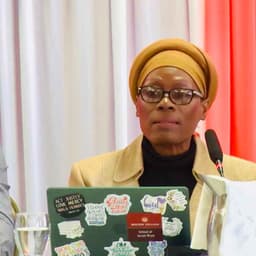

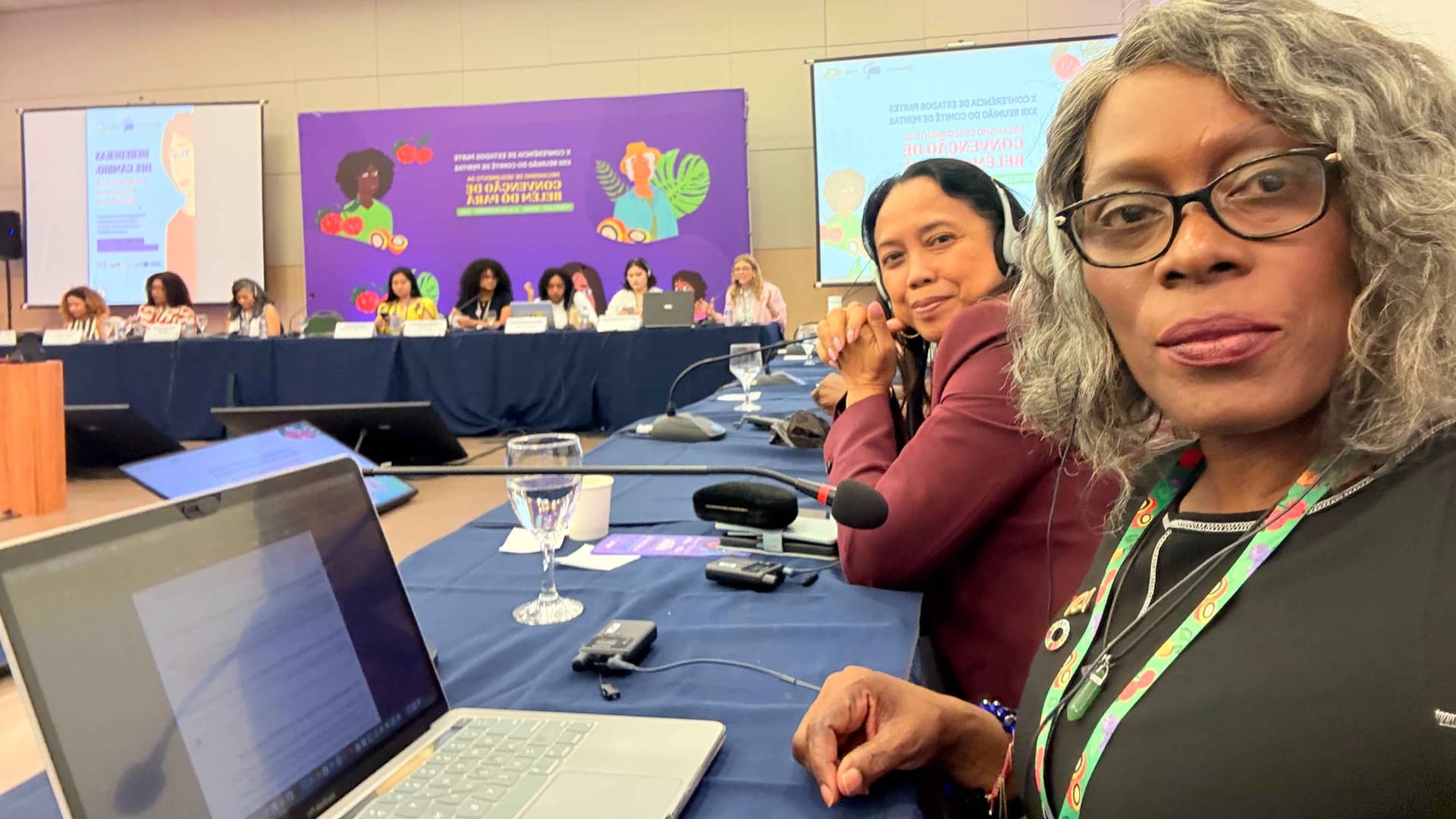
Photo Credit: Sherna Alexander Benjamin
Sherna Alexander Benjamin and a colleague during the MESECVI Experts Negotiation Session
We live in a world where social, economic, and relational instability continues to undermine the lives of women and girls and low-income communities. Many of whom have lived their lives in conflict from the presence of wars and civil unrest to the violence of living in unsafe residences, lack of access to education, challenges accessing funding to establish businesses, and the funding to experience academic and professional mobility. We live in a world where many women and girls are dying physically and emotionally, where they have resigned themselves to their fate, rather than having the resources to embrace opportunities to change the trajectories of their lives.
One question has been circling for decades, like a broken record, within donor convenings, policy forums, peacebuilding spaces, and development work, as well as in the hidden offices of philanthropic actors. This question is "What does Peace Mean to You?" What is sad about this question is that in most cases, it is asked with 'good intentions,' and with a level of seriousness, and most times, posed to women and girls, low-income or no-income populations, and individuals living in socioeconomically deprived communities whose lives continue to be shaped by systemic instability, exclusion, scarcity, conflict, and social and economic precarity.
The question has become tiring, ethically hollow, performative, and lacking substance. Not because discussions about peace are unimportant, but because many of the people and institutions who ask the question rarely practice or embody peace themselves. This question is leading to moral and intellectual fatigue.
It is time that individuals and institutions stop asking the question, as they are also enabling a culture that romanticizes peace for populations and communities that have never experienced it, especially for those whose lives have been and continue to be shaped by wars, civil unrest, and various forms of violence and exclusion.
Peace that is not modelled is not peace: it is abstraction in its most amplified form. And abstraction favors those who are insulated from harm; it's their luxury. Peace that is not practiced is one of the most harrowing entertainments performed hidden in plain sight.
The Problem
Asking women and girls, populations from socioeconomically deprived and exploited communities, to define peace while enabling oppression, denying them access to resources, safety, stripping them of their human dignity, and opportunities for upward mobility, is not inclusive; on the contrary, it is horrendously extractive for women and girls and populations from exploited communities whose lives have never known socioeconomic stability.
Peace becomes something romanticized and an abstraction rather than something that is lived. Development actors, institutions, philanthropists, and governments continue to sell women and girls a promise: that fighting harder, pursuing education, using their voices in peace processes, or sitting at decision-making tables will improve their countries, communities, and their lives. Yet, representation without an authentic redistribution of power, resources, and opportunities does not produce peace; it delivers high-level performances, optics, tokenism, and ticking boxes.
Most concerning is that many of the institutions, groups, countries, systems, and people designing peace models, trainings, and talks, are some of the same sources of conflict and harm, control, exclusion, and those who erect barriers for women and girls. This contradiction is concerning, as it also undermines legitimacy and neutrality and erodes trust.
The Culture of Romanticizing Peace for Those Who Have Only Known Conflict
The romanticization of peace is a lucrative market for many. Peace becomes theoretical when it is absent from lived experience. Women and girls are consistently asked to imagine futures that structures and systems are designed to hinder. Their visions are curated in stories and archived. Harvested for institutional reports that ninety-nine percent of the population never reads. Women are often called upon to share their experiences and visions with various audiences, where their names and experiences are sometimes forgotten before they exit those spaces; however, their stories and visions are often used for emotional marketing to attract more donors. You see, even peace has become a business in its own right. At the same time, the systemic and structural conditions women face remain unchanged. Such practices place an unfair intellectual and emotional burden on women and girls to express hope in institutions, environments, and governments that unfailingly deny it.
Selective Inclusion and Hierarchies
Peace cannot co-exist with harmful systems and scarcity-based access to positions and power. Such processes elevate a few women and girls into positions of influence and control, while leaving systems in place that reinforce exclusion—promoting hierarchical systems rather than transforming them. In many spaces, institutions, and engagements, especially those that are constrained, many women are overtly or covertly incentivized to reproduce vertical power over other women, thereby enabling a culture of exclusion for many women, rather than modeling horizontal power-sharing to co-design models that shift paradigms. Peace will continue to collapse, especially when systems are selective, vertical power is venerated, access is conditional, and solidarity is fragmented and biased.
Narrative as Capital: The Extraction of Women and Girls' Pain
Women and girls' experiences of survival and conflict are too often extracted, curated, leveraged, and framed as marketing tools to attract legitimacy, funding, and visibility. This framing is costly for women and girls, presenting them as victims and helpless in need of saving, casting them in a deficit position, rather than as capable agents with assets and strengths constrained by systemic and structural barriers. The problem is not women and girls' abilities or their capacity; it's the socioeconomic, political, and religious constructed systems that suppress them.
Recommendations:
The Response that Peace Requires is for women and girls to begin shifting the narratives. They must start to use Refusal as Radical Agency: Women and girls must refrain from answering the question "What does peace mean to you," and shift the attention to the systemic barriers and institutional accountability.
Leaders' responses must be aimed at eradicating structural and Systemic Barriers: dismantling barriers to networking, funding, socioeconomic upward mobility opportunities, and safety that restrict women's upward mobility and invalidate their visions, dreams, and aspirations.
Funders, donors, philanthropists, and leaders must move beyond good-intention giving that most times lack measurable and sustained impact towards establishing sustainable approaches, moving funding and other resources towards: Shifting to Sponsorship Models: While mentorship has some merits and advises women and girls, sponsorship transfers access, shares power, reduces risks, and positions women and girls of all ages to seize opportunities for unleashing their potential.
Model Institutional Peace: Institutions and leaders must demonstrate peace through non-extractive engagement, ethical governance, transparency, access to funding, and removal of selective inclusion.
Asking women and girls to define peace repeatedly, especially when systems and structures are not changing, is bordering on violence against them. Peace is a process; it involves ethical decision-making and equitable access to resources. Peace is about developing a culture and practice that must be modeled and shared. A culture and systems where women and girls have the resources to design and create the lives and futures they alone can imagine. It is not rhetoric but practice. And that is what peace means to me: anything less is violence, not peace.
- Economic Power
- Leadership
- Education
- Peace & Security
- Peace Building
- Peace Is
- Global