
Stale Content Loses in 2026: How KWT Spider 2.0 Audits Freshness at Scale
Aug 10, 2026
story
Seeking
Visibility


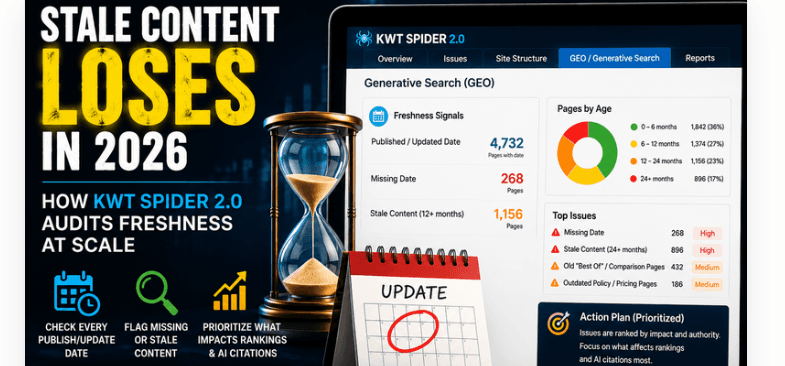
Photo Credit: KWT Spider 2.0 / Original illustration
KWT Spider 2.0 audits content freshness across an entire site, helping identify stale pages and prioritize updates.
The New Cost of an Old Page
AI search engines don't just rank content anymore — they retrieve it and retrieval systems have a bias traditional rankings never had before as they now favor what's recent. A page that's technically well-optimized but hasn't been touched in two years is increasingly likely to lose its citation to a competitor's page updated last month, even if the older page is more thorough.
This changes how freshness audits need to work. It's no longer enough to check whether a page ranks. You need to understand how old your content is across the entire site—and which pages are losing relevance in both traditional search and AI-generated answers.
Why freshness became a ranking signal for AI
Generative search tools construct answers by pulling from sources they trust to be current. For anything time-sensitive, an outdated page isn't just weaker, it's a liability:
- Pricing pages — a model can't cite a number it can't verify is still accurate
- Specs and product details — stale specs risk citing something that's since changed
- Policy pages — terms, return policies, compliance info all shift over time
- “Best Of” Content Needs Regular Refreshes — these tend to age the fastest because the products, features, and options they cover are constantly changing.
If a model can't confirm a page reflects the current state of a topic, it looks elsewhere. That means published and updated dates are no longer just cosmetic details—they’ve become important trust signals that AI systems may evaluate alongside author information and other E-E-A-T signals.
The problem: freshness is invisible at scale
On a five-page site, checking freshness is a five-minute manual task. On a 5,000-page site, it isn't. Content teams typically know their newest posts are fresh and assume the rest is "probably fine" — until an audit shows entire categories haven't been touched since a redesign two years ago.
The pages that quietly go stale tend to be the ones nobody's actively managing:
• Old comparison posts that were accurate at launch
• Legacy product pages tied to discontinued or updated offerings
• Evergreen guides that were "finished" and never revisited
• Category or hub pages that don't get the same editorial attention as flagship content
Individually, each is low priority. Collectively, they're often a large share of a site's indexed content.
How to audit freshness across a full site
A proper freshness audit needs three things:
- The published/updated date for every URL, pulled directly rather than estimated
- A way to flag pages missing that data entirely
- A way to segment by age so you can prioritize fixes instead of trying to update everything at once
This is where KWT Spider 2.0's crawl handles the heavy lifting. Running a full site crawl with GEO enabled pulls author and date signals directly from meta tags and schema markup across every URL — not just the pages you remember to check. Pages missing date information entirely get flagged as a specific GEO issue, since a missing date is treated the same as a stale one from an AI system's perspective.
On larger sites, this matters more, not less. KWT Spider's SQLite/DB mode keeps a 50,000+ URL crawl responsive, so a freshness audit on a large site doesn't mean waiting hours for results or working from a sample. The Generative Search tab surfaces date and author data alongside the rest of the GEO signal set — definition, FAQ schema, summary structure — so freshness shows up as one line item in a broader citation-readiness picture, not a separate project.
Turning the audit into a plan
Once you have a clear view of every page’s age, the next step isn’t rewriting everything—it’s deciding which pages actually need attention first:
- High-traffic, time-sensitive pages first — pricing, specs, policies
- High-authority pages next — pages with strong internal linking that AI systems are more likely to surface
- Evergreen content last — often just needs a light review and an updated date, not a rewrite
- Orphaned or unlinked stale pages — decide whether to update, consolidate, or remove entirely
The Action Plan view sorts issues by priority and potential impact, so a missing-date issue on a high-authority page gets attention before the same problem on a page with little or no internal linking. That's the difference between fixing what actually affects citations and just working through a list top to bottom.
The takeaway
Freshness used to be a nice-to-have for SEO. In an AI retrieval environment, it's closer to a gate: content that looks outdated gets passed over regardless of how good it is. Auditing for it manually doesn't scale past a handful of pages. Auditing for it as part of a full crawl — where date and author signals sit next to every other citation-readiness check — does.
- Technology
- Education
- Internet Access
- Digital Skills
- Shout Your Vision
- Behind the Headlines
- Global