
PEACE IS…..A GIRL WHO KNOWS HOW TO SAY NO
Apr 27, 2026
story
Seeking
Visibility


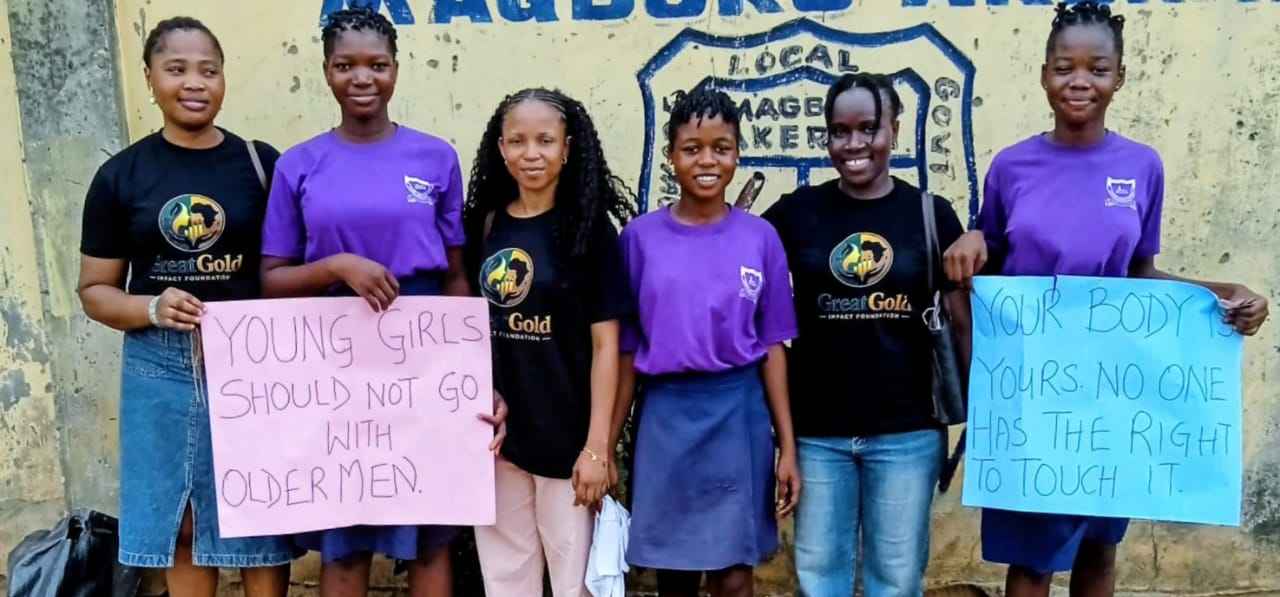
GreatGold Impact Foundation school Visi
I want to tell you what peace looks like in a Nigerian slum.
It does not look like what you might imagine when you hear the word. There are no bombs falling in Bundu Waterfront, the neighbourhood in Port Harcourt, southern Nigeria, where I grew up. There are no soldiers on the street corners, no formal declaration of war. But there is conflict here, quiet, domestic, deeply gendered conflict and it has been claiming girls for generations.
Bundu Waterfront is a waterside community where cult gangs recruit boys before they finish primary school. Where drug abuse moves through the streets like weather. Where teenage pregnancy is so common it has stopped being a tragedy and become a statistic. The conflict here does not make international headlines. It does not get documented in crisis reports. But it is real, it is violent, and it steals futures every single day.
And its primary targets are girls. I was one of those girls.
I never knew what peace felt like as a child not because I had experienced war, but because I had never experienced safety.
Not the kind of safety that lives in the body. The kind that lets you walk home from school without your heart hammering. The kind that lets you ask a question without shame. The kind that gives a girl language for the things she is seeing and experiencing around her, so that she can name them, report them, and resist them. I had none of that.
One afternoon, walking home from primary school through a bush path near our home, an older man called out to me. He was pulling down his trousers. I did not know the word for what he was doing. I did not know it was a crime. I did not know it was the beginning of a pattern that millions of Nigerian girls live through every year. I knew only one thing;run. And I ran.
I never told anyone. Not my mother. Not a teacher. Not a friend. Because nobody had ever told me that I could.
That silence was not peace. That silence was the conflict.
In Nigeria, as in many parts of the world, sexual exploitation does not always arrive with force or violence. It arrives with gifts. With flattery. With an older man often wealthy, often respected who targets a young girl living in poverty and offers her things her family cannot. A phone. School fees. Food. Attention. It is called "sugar daddy" culture, and it is one of the most insidious, most normalised forms of gender-based violence on the African continent.
It is insidious because it does not look like violence.
It is normalised because nobody talks about it.
And it thrives in communities like the one I grew up in communities where girls are already vulnerable, already hungry, already invisible and where the silence around sexuality is so deep that a girl can be groomed, exploited, and left with an unplanned pregnancy before anyone around her even registers that something wrong has happened.
This is not peace. This is a different kind of war.
Last month, I walked into some secondary schools with a mission that was deeply personal.
I was going back for the girl I used to be. We talked about their bodies, who they belong to, what nobody has the right to take, and why speaking up is not betrayal but survival.
And then something happened that I had not fully expected.
They spoke. The questions came like water that had been held back too long. They were raw and urgent and heartbreaking. One girl asked how to tell if a man is dangerous when he is kind and handsome. Another asked if she had done the right thing by reporting her mother's tenant, who had shown her a pornographic video. Another asked what to do if it is a classmate, not a strange man who is touching her without permission.
These were not hypothetical questions. These were girls reporting from their own frontlines.
Peace Is — A Girl Who Knows How To Say No. Who can ask questions and speak freely.
Peace, for a Nigerian girl growing up in a low-income community, is not abstract. It is not a treaty between nations. It is the ability to walk home from school without fear. It is knowing that her body belongs to her and that she has the right to say so. It is having a trusted adult she can run to when something wrong happens and knowing she will be believed.
Peace is a girl who knows how to say no.
Peace is a classroom where that girl can ask any question without shame.
We are nowhere near enough of that peace yet. In Nigeria, one in four girls experiences sexual violence before the age of eighteen. The majority never report it. The silence is not peace, it is surrender. And it will continue for as long as we treat the sexual exploitation of girls as a private, cultural, or family matterrather than what it is: a crisis that demands an urgent, coordinated, community-wide response.
If I could share this story with global leaders, I would say this:
Peace does not begin with treaties. It begins in classrooms. In the conversations a girl has access to before she walks down a bush path and meets a man with dangerous intentions. In the language she is given before a peer pressures her into something she does not understand. In the trusted adult who is trained, supported, and empowered to listen.
Peace is possible. But it has to be built deliberately, in the places and among the people who need it most.
I am building it one school visit at a time. One girl at a time. One honest conversation at a time.
PEACE IS....
- Peace & Security
- Peace Is
- Africa