
NIGERIA: She Said She Was in Pain. I Was There to Listen.
Mar 31, 2026
story
Seeking
Encouragement


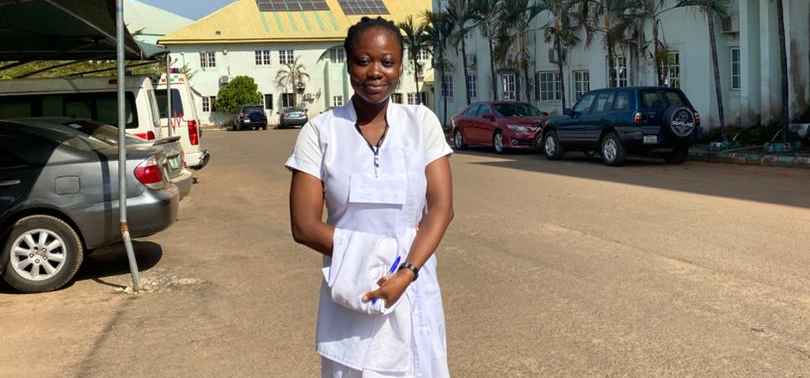
During her Gynecology rotation, Linda, a medical student, witnessed a woman in pain being dismissed by the very doctor meant to help her. So she chose to step in.
“Women do not need to be believed more—they need to be doubted less.”
As a medical student, I had my Gynecology and Obstetrics rotation last year. It was an eye-opening experience. I saw, firsthand, the issues women faced and actively participated in their care. I learned a lot. Sadly, I also witnessed many cases of medical misogyny.
Medical misogyny is the quiet, often invisible bias in healthcare that causes women's pain to be dismissed, their symptoms to be doubted, and their diagnoses to be delayed simply because they are women.
One case stayed with me.
A patient came in to have her stitches removed. The wound site was slightly inflamed, and the woman was clearly in pain.
When the doctor began the procedure, she struggled to stay still. He told her firmly to keep still, but she kept moving through the pain. Frustrated, the impatient doctor walked away.
I immediately intervened.
I went to her bedside, held her hands, and helped calm her down. After a few minutes, she relaxed. I gently explained why the stitches needed to be removed, then went to inform the doctor that she was ready. He returned, and throughout the procedure, I stayed beside her—holding her hand, apologizing for the discomfort, encouraging her to endure. It worked. She got through it. She received the care she needed.
For the rest of the visit, she told me what the doctor said and asked what I thought. She thanked me before she left.
That is how I, a student, intervened. I felt so fulfilled in that moment because I helped prevent what could have been a negative healthcare experience for her.
The doctor in question was not bad. But his response reflected a much larger issue. This is not an isolated event. Medical misogyny is something that happens worldwide.
Women's symptoms are often ignored or delayed in diagnosis because their pain is not taken seriously. We see this clearly in diseases like endometriosis and some autoimmune conditions. Women's pain is easily and often labelled as anxiety or dismissed as hormonal.
This bias has roots as far back as ancient Egypt, when women were diagnosed with "hysteria", a term used by Greek, Roman, and Western doctors until the late 19th century.
Why does medical misogyny persist?
Several theories exist. One reason is historical bias. Medicine has historically been a male-dominated field, and most studies were male-centered, pushing issues specific to women to the margins. Second, the harmful stereotype that women are overly emotional and cannot accurately communicate their symptoms causes doctors to downplay — and in some cases, completely ignore — women's lived experience. Women are told, straight up, that their symptoms are all in their heads.
In my country, Nigeria, this bias runs deep. Society is still predominantly patriarchal, and many women are financially dependent on a male figure — a husband, father, or other family leader — and must first convince these men they are unwell before medical care is even sought. This is one strong contributor to Nigeria's very high maternal mortality rate: 993 deaths per 100,000 live births.
The consequences of medical misogyny cannot be ignored.
Physically, missed and delayed diagnoses lead to serious complications: chronic pain, deformities, and in some cases, death.
Emotionally, the impact is just as severe. Women who are dismissed begin to doubt themselves. They stop reporting symptoms because they've been taught not to trust what their own bodies are telling them.
Eventually, women lose trust in the healthcare system entirely. They turn to self-medication, seek help from the wrong sources, or avoid care altogether.
During one of my community medicine postings, I spoke with women who had given birth. I discovered that some no longer trust hospitals because their pain was ignored when they needed care most. One woman shared that she would not deliver her next child in a hospital.
These experiences have shaped my view of the medical profession deeply. I've come to understand that one bad experience can literally determine whether a woman recovers or declines.
Every woman deserves to be treated with dignity. Her concerns deserve to be heard with respect. And if her worries turn out to be unfounded, that, too, must be handled with care, understanding, and respect.
This is why we need greater representation for women in healthcare. More research into conditions that affect women. Medicine made by women, for women.
This is why I'm speaking up because this bias needs to be named, challenged, and changed.
STORY AWARDS
This story was published as part of World Pulse's International Women's Day campaign, Stronger Together. Aligned with this year's theme, #GiveToGain, World Pulse invited community members to share a time they showed up for another woman or girl, and the ripple of change that followed.
- Stronger Together
- Featured Stories
- Global