
From Silence to Solidarity: How Youth Across Borders Are Reclaiming Mental Health as a Col
Mar 2, 2026
story
Seeking
Visibility

I did not begin my mental health work with a strategy document or an institution behind me. I began with listening.
In 2018, when conversations around depression and anxiety were still considered taboo in many parts of India, I created a small online space called You Are Not Alone. Within minutes, messages began arriving—hundreds of them. People were not asking for solutions. They were asking for someone to hear them without judgment.
What I learned then has shaped everything I do now:
mental health suffering is rarely individual. It is produced by silence, inequality, and disconnection.
When Distress Is Structural, Silence Becomes Dangerous
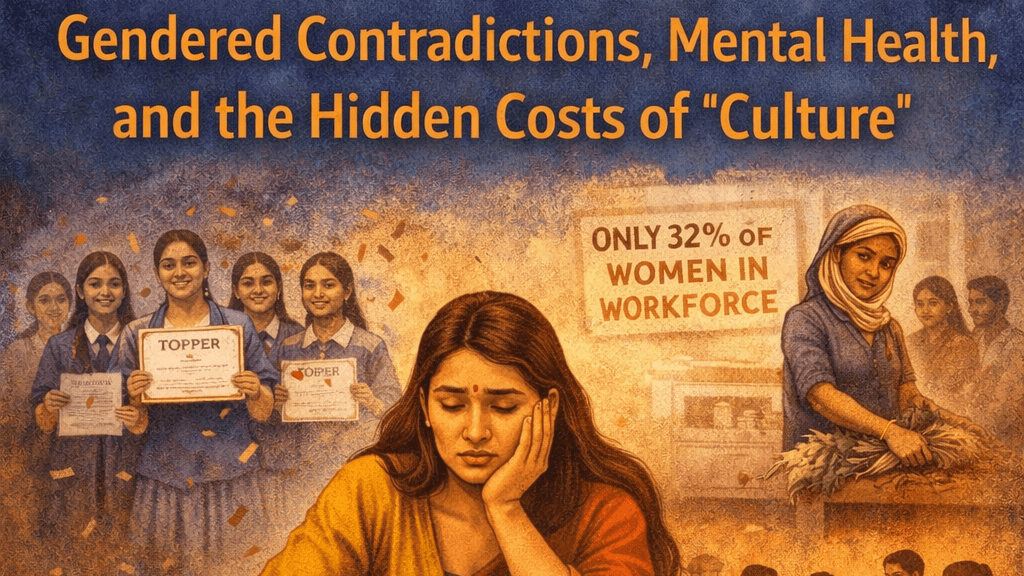
Across communities, I encountered women who were educated but economically dependent, visible online but silenced at home, praised for resilience while denied care. Many were told their pain was normal—a duty of womanhood, marriage, or sacrifice. Others were spiritualized, blamed, or dismissed.
Over time, I began to understand that much of what we call depression is actually a rational response to unjust systems—systems that extract care, labour, and emotional endurance without protection or recognition.
This is not unique to one country.
According to the World Health Organization, India alone is projected to lose approximately USD 1.03 trillion between 2012 and 2030 due to mental health conditions, driven by reduced productivity, unemployment, absenteeism, and long-term social consequences. Yet this crisis is global. Around the world, people are navigating economic precarity, gendered violence, digital hostility, and shrinking social support—often alone.
Mental health has become a mirror reflecting how unequal our societies truly are.
Why I Turned to Youth—and Beyond Borders
As I continued this work, one question stayed with me:
If institutions are slow to change, who can move faster?
My answer has been youth leadership.
Young people are living at the intersection of multiple crises—mental health, climate anxiety, insecure work, and digital harm. But they are also uniquely positioned to challenge outdated norms. Unlike older systems, youth networks move across borders naturally, sharing stories, strategies, and solidarity without waiting for permission.
This is why my work consciously expanded beyond local communities to connect youth across regions—journalists, advocates, researchers, filmmakers, and students—who are asking similar questions in different contexts:
• Why is care invisible?
• Why is silence rewarded?
• Why are women blamed for structural failures?
What Youth-Led Change Looks Like in Practice
Across borders, I have seen youth-led action take many forms:
• Creating safe dialogue spaces where mental health is discussed without shame
• Questioning media narratives that sensationalize women’s lives while ignoring systemic violence
• Using storytelling, research, and art to make invisible pain visible
• Advocating for mental health to be treated as a policy and justice issue, not only a medical one
These efforts may look small in isolation, but together they form a powerful counterforce to stigma and neglect.
Youth are not waiting to be “included.”
They are already building alternatives.
Reclaiming Mental Health as a Collective Responsibility
One of the most dangerous myths around mental health is that healing is a private journey. My experience tells me the opposite: people heal when systems change.
When families learn to listen.
When work respects care.
When media tells fuller stories.
When digital platforms are held accountable.
Mental health improves not because individuals try harder, but because societies become fairer.
I am happy to share that my work has been recognised globally
Achievements
• Peace Ambassador, Institute of Economics and Peace, Sydney (2024)
• Youth Advisory Board Member, Rockflower, New York (2016–2019)
• Peer Review Board Member, The Journal of Patient Experience (2026–2028)
• Goldin Global Fellow, Chicago (2025)
• QS Impact Council President (2025)
Memberships
• Member, Paris Committee on Capacity Building (PCCB)
• Member, Black Professionals in International Affairs (BPIA)
Awards and Global Recognition
• Nominated for the Right Livelihood Award (Alternative Nobel Prize) – 2025
• Invited to discuss the You Are Not Alone initiative with Ursula von der Leyen, President of the European Commission
• Accepted at the European Academy of Diplomacy for work on Gender Equality, Mental Health, and Climate Change
An Invitation to the World Pulse Community
World Pulse community who believes that mental health, gender justice, and dignity are inseparable from democracy and development, I invite you to be part of this global, youth-led campaign.
Please contribute your two minutes and share your views.
- Gender-based Violence
- Global