
From landslide loss to climate Action for our land
May 11, 2026
story
Seeking
Visibility


Love for mother nature
It started on a normal day, scrolling through TikTok and other social media platforms. Video after video kept passing—entertainment, opinions, short clips of people sharing their lives. Then I came across something that stayed with me longer than expected. People were being asked simple questions about climate change. Many laughed. Some said they had never heard of it. Others dismissed it completely, saying it was exaggerated or not real. That moment stayed with me.
Because for me, climate change is not an online debate. It is something I have seen affect the place I live.
I come from Kangema sub County, a rural area where life is deeply connected to the land. Farming is not just an activity here—it is survival. The land feeds families, pays school fees, and holds generations together. Every season depends on the stability of the soil and the reliability of the rain. But over time, the rainfall patterns have not remained the same. The rains no longer come as they used to. Sometimes they delay, then fall suddenly and heavily. Other times, they come with intensity that the land cannot hold. These shifts have made life more uncertain, especially for farming communities like ours.
In these changing conditions, landslides have become more frequent and more destructive.
I remember one night clearly. It had been a normal day, and the rain came later, as it often does now—sometimes without warning, sometimes building quickly. Nothing about that evening felt unusual at first. But in the middle of the night, everything changed. A sudden sound broke through the darkness. It was not something you could easily explain—just a heavy moment where the ground felt like it had given way. Then came confusion. Voices calling out. Children crying. People trying to understand what was happening while it was still dark and raining. There was nowhere clear to run. It was night, the rain was heavy, and the land itself felt unstable.
Our majani shamba, the tea farm we depended on, was swept away down the slope. The crops we had planted and cared for over months and years disappeared with the moving soil. Other food crops were destroyed too. What had taken so much effort to build was gone in a single moment. The land itself changed. After the landslide, some areas became hard and unstable, making it difficult to farm again. Soil fertility reduced, and the ground that once supported life became unproductive in parts. Farming, which had once been predictable, became uncertain and fragile.
We were fortunate that our house remained standing. But many of our neighbors were not as lucky. Some lost their homes. Others lost their lives. By morning, everything looked different. Familiar paths were broken, the land was scarred, and silence had replaced what used to be a living community.
We were later taken to near by Primary School for refuge. Life there was extremely difficult. Classrooms became living spaces. Children slept on cold floors. Food was limited, and every day felt like a struggle to meet basic needs. Privacy disappeared, and survival became the focus. Women carried heavy burdens trying to care for families in conditions never meant for living. Children struggled emotionally, trying to understand why their homes, their land, and their normal lives had suddenly disappeared.
Beyond the physical loss, there was something deeper that stayed long after the waters receded—the psychological impact. The fear of every rainy season, the memories of that night, and the uncertainty of whether it could happen again never truly leave. For many, rebuilding life is not just about land or homes, but also about trying to heal while still living under the same risk.
When the rains reduced, attention slowly faded. Leaders visited. Promises were made. Humanitarian support came in moments. NGOs and other organizations provided emergency relief—food, temporary shelter, and basic support. For a short time, help was visible and present. But as time passed, the urgency faded, and long-term solutions slowed down. Yet the same communities remained vulnerable, waiting for the next rainy season with the same fear.
What stayed with me most is that this is not an isolated event. It is a cycle that repeats—loss, relief, silence, and then risk again.
That is when I began to realize something deeper. We are not only dealing with landslides. We are also dealing with changing climate patterns, environmental degradation, lack of preparedness, and limited long-term support systems for rural communities whose lives depend directly on the land.
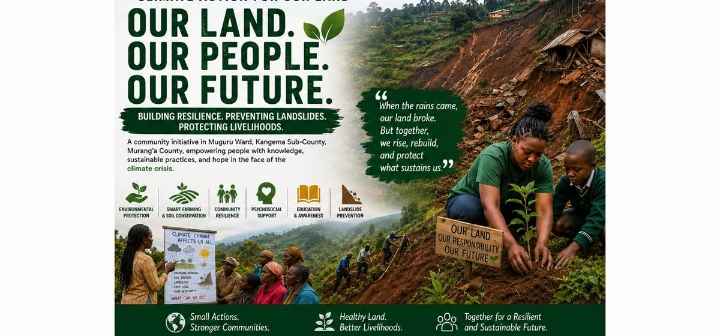
That is how Climate Action for Our Land began. Not as a humanitarian relief effort, but as an action-oriented initiative focused on prevention, education, and long-term resilience.
Most of the people affected here are farmers who depend directly on the land, which means any solution must work with them, not outside them. This initiative is about practical and community-based solutions that respond to real needs on the ground.
It focuses on climate and environmental education in simple, local language, so people can understand what is happening without technical barriers. It also promotes smart farming techniques that reduce soil erosion and improve resilience, alongside tree planting and land restoration to stabilize slopes and recover degraded land. It encourages early awareness and preparedness for extreme weather risks.
It also recognizes something often ignored—the psychological impact of repeated disasters—and the need for community support systems that help people recover emotionally as well as physically. It further encourages collaboration with stakeholders, including NGOs and humanitarian organizations, so that emergency response and long-term resilience work together instead of separately.
This initiative is not only about responding after disasters happen. It is about reducing vulnerability before they occur and shifting from dependency on emergency response to building knowledge, resilience, and self-protection within communities.
Because these communities are not just victims of disaster. They are farmers, land stewards, and families who deserve systems that help them adapt, not only survive.
If we begin to act differently—combining knowledge, practical farming solutions, environmental care, and emotional support—then fewer families will have to experience what we went through.
This is not just my story. It reflects what many rural communities are experiencing as climate patterns continue to change.
We cannot continue treating landslides as isolated tragedies that end when the rain stops. We need long-term action, education that reaches people in simple language, farming systems that protect the land, mental health awareness for affected communities, and coordination between communities, youth, NGOs, and institutions not only during disasters, but before them.
I am calling on all stakeholders—leaders, educators, NGOs, youth, and communities—to move beyond emergency response alone.
Let us invest in prevention, resilience, and understanding, because protecting the land is not just about saving property, but about saving lives, dignity, and the future of entire communities.
- Environment
- Earth Emergency
- Global