
Bare feet,Heavy dreams
Feb 8, 2026
story
Seeking
Action


Bare Feet, Heavy Dreams
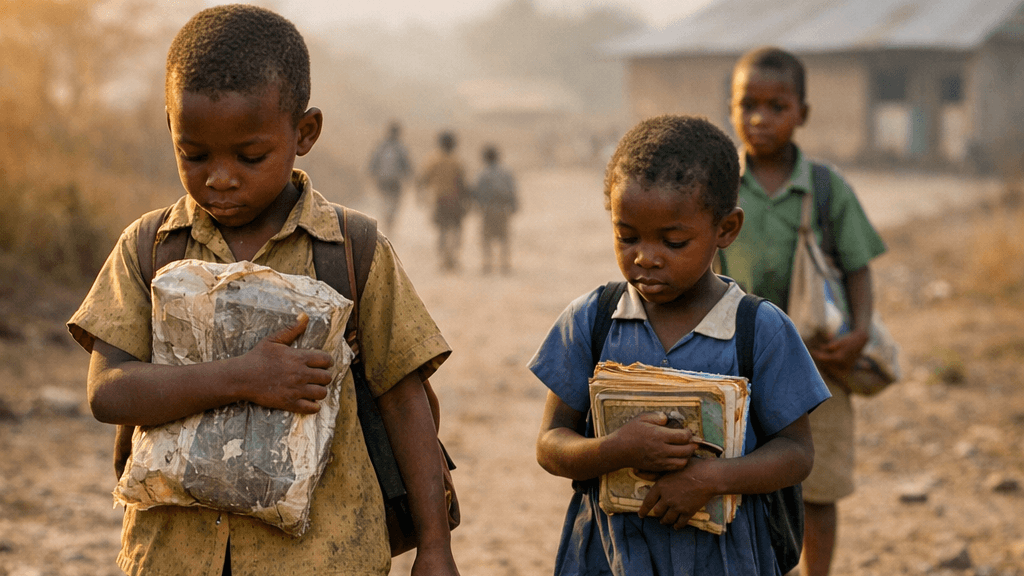
Every morning before the sun fully rises, small figures begin to move along the dusty roads of my community. They walk quietly, their shadows long and thin against the earth. These are schoolchildren, some barely tall enough to reach the classroom chalkboard. Their uniforms may be clean, but their feet are bare. Their books are carried in plastic bags, or sometimes held tightly to their chests with both arms, as if they are precious treasures that must not be dropped.
I often watch them pass and wonder how much strength it takes for a child to walk kilometers on hot soil and sharp stones just to sit in a classroom. One little girl, Nia, is seven years old. Her hair is neatly braided, and she always smiles when greeted. But her feet tell a different story. They are cracked and dusty, shaped by rough paths and burning ground. She has no shoes, no school bag, and only one exercise book. Still, every day she walks with determination, as though education itself is calling her forward.
Children like Nia do not complain. They do not know another way. They have learned that learning must come with pain.
Without shoes, their feet suffer. During rainy seasons, they walk through mud and dirty water, risking infections and injuries. When the sun is strong, the earth burns their skin. Some arrive at school limping, some hiding blisters, and some staying home because walking becomes too painful. Their absence is not caused by laziness, but by lack.
Without school bags, their books tear and get wet. Homework is lost. Pens disappear. Many feel ashamed when they sit among classmates who have neat backpacks and lunchboxes. That shame grows quietly inside them, whispering that they do not belong. Slowly, some children begin to believe that school is not meant for them. And when that belief takes root, education starts slipping through their fingers.
There is a boy named Musa who dreams of becoming a teacher. He is ten years old and loves numbers. He writes them carefully on scraps of paper he finds at home because he has only one notebook. His books are wrapped in an old rice sack to protect them from dust. When it rains, he stays under a tree, afraid his papers will be destroyed before he reaches school. Still, he walks. Still, he tries.
These children are not asking for luxury. They are asking for dignity.
A pair of shoes is not just footwear. It is protection from disease. It is comfort. It is confidence. A school bag is not just fabric and zips. It is safety for books, order for learning, and pride for a child walking into class feeling equal to others.
Yet in many places, these simple items are treated like unreachable dreams.
Parents love their children deeply, but poverty ties their hands. When food is scarce, shoes become a distant wish. When rent must be paid, school bags feel like a luxury. Mothers and fathers make impossible choices daily: medicine or uniform, dinner or notebooks. In these choices, children pay the highest price.
I have spoken to teachers who try to encourage attendance, but they too see the struggle. They see children with injured feet sitting quietly at the back of class. They see pupils hiding their books under desks because the covers are torn. They see bright minds slowly dim because the journey to school is too hard to continue.
What hurts the most is that these children still hope.
They still raise their hands to answer questions. They still dream of becoming nurses, engineers, and leaders. They still believe education will open doors. Their bodies may be tired, but their spirits are not yet broken.
But hope alone is fragile.
If we allow children to keep walking barefoot into the future, we are telling them that suffering is part of learning. If we allow them to go without bags, we are telling them that their books, and therefore their dreams, do not deserve protection.
This should never be the message of education.
A child should walk to school feeling safe, not afraid of the road. A child should carry books in a bag, not in shame. A classroom should be a place of comfort and focus, not a reminder of poverty.
We must begin to see shoes and school bags as part of education itself, not as extras. Governments, organizations, and communities can work together to ensure that no child walks barefoot into a classroom. Donation programs, school supply drives, and local manufacturing of affordable shoes and bags can transform lives quietly but powerfully.
One pair of shoes can keep a child in school.
One bag can protect a future.
One small act can restore dignity.
When we meet a barefoot child on the road to school, we should not look away. We should ask ourselves what kind of world we are building if children must suffer in order to learn.
Education should lift children out of hardship, not force them to walk through it every day.
Let us imagine a different morning: children walking with light steps, backpacks bouncing, feet protected, faces proud. Let us imagine classrooms filled not with quiet pain but with confidence. Let us imagine a future where no child feels poor before they even open a book.
Bare feet should never carry heavy dreams.
Our responsibility is to make the path softer for them to walk.
- Positive Masculinity
- Environment
- Economic Power
- Education
- Moments of Hope
- Stronger Together
- Africa