
The Sovereign Soul vs. The Political Machine: Why We Must Separate Faith from Religion
Mar 20, 2026
story
Seeking
Feedback


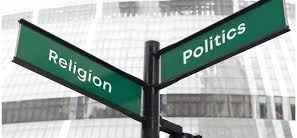
Photo Credit: businessng news image
Crossroad sign
The blurring lines between faith and religion have long been a source of both profound spiritual connection and devastating global conflict. While often used interchangeably, these terms represent fundamentally different spheres of human experience. Understanding this distinction is not merely an academic exercise; it is crucial for navigating the complexities of modern governance, individual liberty, and international relations. This distinction becomes painfully stark when we observe the weaponization of belief for political control.
Recently, a friend shared a harrowing video documenting a crackdown on protesters in an Islamic country. The footage, a grim artifact of the 'Religious State' in action, showed the execution of a nineteen-year-old youth.
To a theological observer, this may appear as a divinely mandated punishment. However, to a political scientist, it is a classic exercise in state-sponsored terror designed to preserve territorial integrity and maintain social control.
In this context, 'divine law' functions as the currency, but the political survival of the regime remains the actual transaction. This stark reality forces us to confront the inherent political nature of religion.
Faith: The Sovereign and Universal Connection
Faith, at its core, is a sovereign, personal experience. It is the intimate, vertical pulse—the silent, sacred dialogue between the individual and the universe or a higher power. This connection is subjective, internal, and inherently non-political. It transcends borders, required no external verification, and operates independently of codified systems or designated authority figures. Faith is a private sanctuary, a space where the individual negotiates their relationship with the infinite without the interference of the state or the collective.
Religion: The Tool of Historical and Political Conquest
Religion, in contrast, is a horizontal structure—a historical and political construct born from the institutionalization of faith. It transforms spiritual belief into a tangible system of doctrines, rituals, hierarchy, and, critically, governance. Throughout history, religion has functioned not merely as a spiritual guide but as the primary engine for territorial expansion and social ordering. Empires and monarchies did not separate the Church or the 'Caliphate' from the Ministry of Justice, the Treasury, or Military Command; they were, for all intents and purposes, a single entity.
The mandate to rule was inseparable from the mandate of the divine, justifying conquest and control on a global scale.
The Great Rebrand: The Evolution of the Political Machine
It is a mistake to view modern governance as fundamentally detached from this historical reality. The transition from one-party states or absolute monarchies to multi-party democracies and secular states is an evolution of governance rather than a complete revolution. Just as a multi-party system manages diverse political interests under a democratic umbrella, our current systems have merely evolved to accommodate multi-religious groups. This accommodates diversity not as an end in itself, but as a mechanism for management, ensuring the longevity and stability of the system.
Asking if an issue is political or religious is a rhetorical trap. Religion is political because it seeks to govern behavior, dictate morality, and organize power on a societal level. The mechanism of control hasn’t changed; it has simply updated its appearance. The crucial variable is not the system itself, but the personality at the helm. The shift from a reformist leader to a hardline autocrat doesn't fundamentally alter the underlying religious texts or the potential for their use as political tools; it changes the application and interpretation of those texts in service of political survival or ideological control. The system remains a neutral machinery of power; only the operator and their interpretation vary.
Conclusion: Reclaiming Faith as a Private Dialogue
This analysis is not intended to undermine the profound depth or beauty of personal belief. On the contrary, by separating faith from the political machinery of religion, we actually preserve its sanctity and relevance. If we accept that man’s relationship with the universe is not a political discuss—and I daresay it is not—then it logically follows that it is also not a religious discuss in the institutional, political sense. It is a deeply personal one.
Recognizing that religion is an inherently political construct is essential to protecting individual sovereignty. It reminds us that our spiritual pulse exists in a dimension that no state gallows, courts, or armies can truly reach. By making this distinction, we reclaim our right to a faith that is truly free from being weaponized by the state for temporal control. Our dialogue with the infinite belongs to us alone, far removed from the horizontal maneuvering of political and religious power structures.
- Human Rights
- Behind the Headlines
- Global