
Plugged In, Charged Up: The Mother's Day Caravan
May 10, 2026
update
Seeking
Visibility

A True-ish Mo‘olelo (Story) of Peace Poles, Brownies, and One Girl Who Said It All or My Dream Mother's Day
District Governor Leilani Kahananui had a motto she'd borrowed from her grandmother: "Aloha kekahi i kekahi." (Love one another.) Then, "If it's worth doing, it's worth doing with forty-seven phone calls and a potluck."
So when she proposed to all fifty-three clubs in her district that Mother's Day weekend would be the occasion for a synchronized, island-wide, EV/carpool caravan to every Peace Pole they could find, people responded the way people always respond to genuinely inspired ideas: with immediate love, immediate panic, and a lot of reply-all emails that could have been texts.
Usually both.
"Leilani," said Club President Marcus Ferreira of the Hilo Sunrise Club, on the fourth of those forty-seven phone calls, "you know three of our clubs still can't find their Peace Poles on Google Maps, right?"
"Marcus, Peace Poles are not hiding. They are standing. Waiting. That is, in fact, the entire point of a Peace Pole."
"I understand the symbolism. I'm talking about GPS."
She exhaled with the patience of a woman who had chaired enough committee meetings to achieve enlightenment. "We will figure it out."
They did not entirely figure it out. Three clubs: Kona Mauka, Maui Upcountry, and one on Oahu whose president later admitted he'd sent the event reminder to his fantasy football group had to reschedule. There were hurt feelings. There were apologies. Governor Leilani sent a personal voice note to each affected club that began, "I love you and this is not the end of the story," which is either the most emotionally generous thing a District Governor has ever said, or excellent evidence that she should have a podcast.
The fifty remaining clubs went anyway.
On the Big Island, the caravan to Hilo's Peace Pole wound through the lush garden of the Liliʻuokalani Gardens earning its reputation in silence. A massive monkeypod tree canopied the gathering space like a cathedral nobody had to pay admission for of light a candle in. The Peace Pole stood at the center, its six faces reading May Peace Prevail on Earth in Spanish, English, Filipino, Hawaiian, Japanese, and Chinese, every language a promise, every promise a whisper of the possibility probability of peace.
Seventy-three-year-old Father Dominic Souza, whom everyone called Father Dom, including himself when he was feeling casual, climbed slowly out of the back seat of the Reyes family's minivan. He was wearing his collar, his best aloha shirt over it, and an expression of pure, uncomplicated delight.
"Miguel," he said to the young man who'd driven him, "I have not been in a carpool since 1987 and I had forgotten how much I enjoy someone else being responsible for the parking."
Miguel's wife, Ana, laughed. "Father Dom, you can ride with us every Sunday."
"I do ride with you every Sunday," he said pleasantly. "We call it Mass."
The group gathered. Someone produced a ukulele. Someone else produced brownies, which Keoni (DG Kahananui's grandson) located with the radar unique to seven-year-olds.
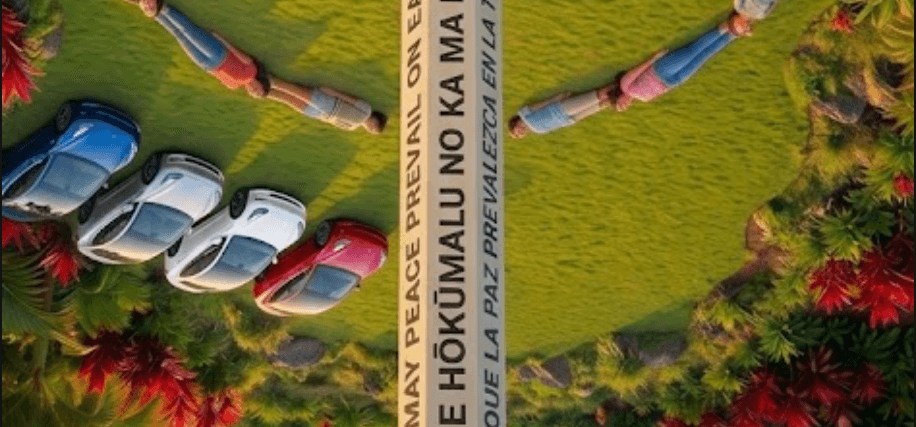
Then Leilani said, "Before we do anything, can we try something? Can everyone make a peace symbol with your body?"
There was a collective pause, the kind that happens in groups of adults when they're being asked to do something that sounds vaguely like middle school gym class.
Father Dom raised one hand. "I am seventy-three years old and I recently discovered my left knee has range anxiety. How far does this peace symbol thing go?"
"Not far, Father. We need a circle, a vertical line, and two diagonal lines."
What followed was one of those moments that could not have been planned. Teacher, priest, young couple, retirees, a man in a business shirt who had driven straight from a meeting and was still wearing his lanyard, arranged themselves into a peace symbol. But because Leilani had been thinking about this all week, she had them flip it.
Right-side up. The way it looks when a tree extends upward, like outstretched branches. Like something rising. Like a tree growing to the light of the sun.
"Oh," said Father Dom softly, looking at what they'd made of themselves. "Oh, this is something."
Keoni, who had positioned himself as the top of the vertical line, looked down at the circle of people below him and said, with absolute seriousness: "I'm the top."
"Yes, darlin'," said his mother. "You are absolutely the top."
The caravan near Kona took a different shape.
Fourteen-year-old Zoe Tanaka had ridden in her dad's Tesla 3 (white, whisper-quiet, charged to 79%).
"Dad," Zoe said, somewhere around mile eleven, "I wrote something."
"I know," he said. "I heard you at midnight."
"How?"
"You pace when you write. The floor creaks."
She looked at him. "You could have said something."
"And interrupt a poet? Absolutely not."
At the Peace Pole, after the songs and the silence, Zoe stood up.
She was wearing her tan Senior Girl Scout vest. She had her phone in her hand and she was terrified, and she did it anyway.
She read:
The Charged & Still
We did not roar here.
We hummed.
Silent as a cat stalking one of Hawaii's native birds,
steady as a kept promise
the car holding its breath
so the world
could finally
be heard and breathe-clean, fresh air.
And the world had things to say.
The sea said, I am never full.
The wind moved through the trees
the way grief moves through a family,
without asking,
without apology,
and somehow still gentle,
waved welcome.
I am fourteen.
I am standing at a pole
that asks the impossible
in six languages
"May Peace Prevail in Earth"
as if peace were a thing
you could simply ask for.
But maybe it is.
Maybe it's this.
Maybe peace is just
enough people
showing up
to the same place
at the same time
with their windows wide open
and their hearts
not quite closed.
My mother is the one who told me
that peace isn't quiet.
it's honest.
It's the conversation
you finally have.
It's the phone call
you stop putting off.
It's the apology
that arrives
a little late
but arrives.
She taught me the difference
between arriving
and showing up.
Arriving is the easy part.
You just go somewhere.
But showing up,
showing up means
you brought the part of you
that was afraid to come.
The tender part.
The unfinished part.
The part that still grieves
and still hopes
and still, somehow,
believes.
I believe.
I believe in every car
that hummed here in silence,
in every garden
that keeps growing
while we aren't looking.
That is exactly
where peace starts.
Not in the treaties.
Not in the charters.
Some things
are planted
not to be seen
but to be found
by someone
who needed them.
You found it.
You are here.
You showed up
the whole you.
And may it prevail
finally,
stubbornly,
tenderly
in you.
Not someday.
Now.
In the next breath you take.
In the next person you see.
In the next moment
you choose
to show up
whole,
and humming,
and here.
— Zoe Tanaka, age 14, Kona, Hawaiʻi on Mother's Day, Plugged In, Charged Up Caravan
Nobody said anything for a moment.
Because that, that is the whole thing, isn't it.
That is, in six languages or fifty-three clubs or one creaking floor at midnight, the entire point.
Later, Father Dom would eat two brownies and call it communion.
Keoni would ask if the peace pole could also do homework.
And Leilani would begin, without meaning to, phone call number forty-eight. She, who had coordinated fifty clubs and forty-seven phone calls and survived three reschedules and one fantasy football miscommunication, looked at Zoe and then at the pole and then at the people and thought: This. This is exactly what I meant.
Happy Mother's Day to the ones who are present, and to the ones who are home and in every way here.
- Leadership
- Peace & Security
- Earth Emergency
- Indigenous Rights
- Peace Building
- Climate Change
- Impact Lab
- Global